[UZ]Bukhara, Uzbekistan
Suzani, the embroidery brides carried across the Silk Road
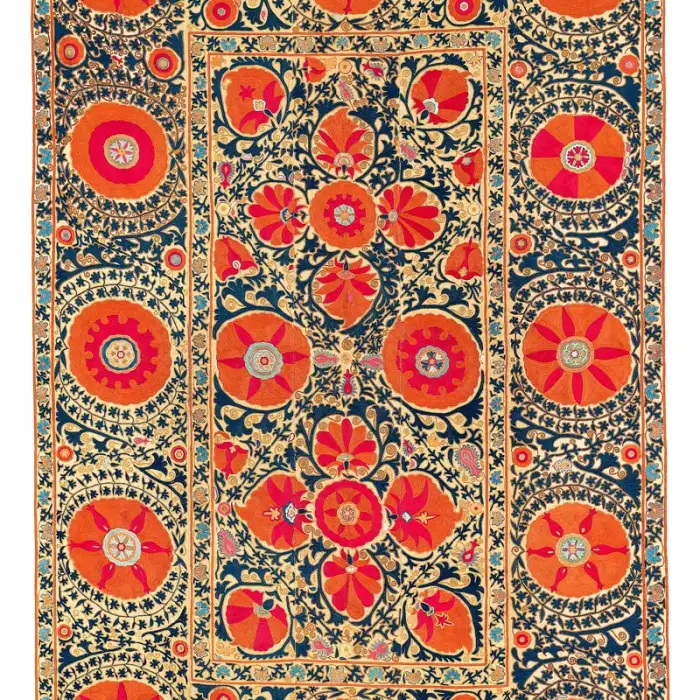
In Bukhara a suzani was begun at a daughter's birth and finished for her wedding, panel by panel, by many hands. The stitches still carry sun discs and pomegranates.
Suzani takes its name from the Persian word for needle. In Bukhara, Samarkand and the towns between, a bride's household embroidered large cotton or silk panels for her dowry: sun and moon discs, pomegranates for fertility, vines that never quite close, because only one maker is perfect. Work started when a daughter was born and the panels were joined for her wedding.
The cloth is worked in strips on a frame, often by several women at once, then sewn together, which is why the pattern jogs a little at the seams. Chain stitch and couched silk cover the ground almost completely on the richest pieces. Old suzanis hang in museums; new ones are still made the same way in Bukhara's workshops.
Ikat, dyed thread by thread before weaving, comes from the same streets. A real suzani from a Bukhara needle lists on 1VIM with the maker's pin on the old Silk Road, and the door price shown before you pay.
More stories
- Celadon, the green glaze of Chiang MaiThe crackled green of Thai celadon comes from wood ash and iron, fired blind at over 1,200 degrees. The Lanna kilns around Chiang Mai never stopped making it.
- Cusco weaving, the cloth that predates the IncaIn the villages above Cusco, weavers on backstrap looms turn alpaca fibre and cochineal red into cloth whose patterns are older than the empire that made the city famous.
- Huipil, the blouse that names a villageA Maya weaver's huipil tells you where she is from before she says a word. The patterns are village signatures, woven on the same backstrap looms as a thousand years ago.