[GH]Accra, Ghana
Krobo beads, the glass Ghana melts back into colour
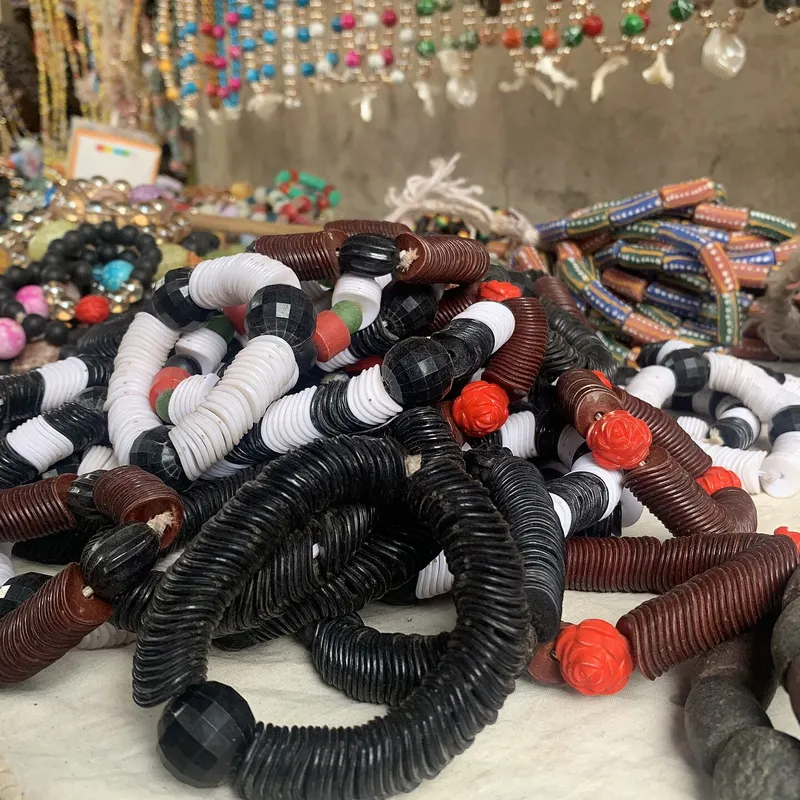
In the Krobo hills east of Accra, broken bottles are ground to powder, layered into clay moulds and fired into beads that have carried meaning at births, weddings and funerals for generations.
The Krobo people of Ghana's Eastern Region have made glass beads for well over a century, and the raw material is whatever glass the world throws away: bottles, window panes, old jars. The glass is washed, broken and pounded in a mortar into a fine powder, then sifted by colour. A bead maker builds a mould from local clay with a cassava stalk through the middle for the hole, packs the powder in layers, and fires the mould in a kiln built from termite mound earth. The powder fuses into a bead in the shape of the mould; painted beads get their stripes and dots drawn on with a needle and fired a second time.
Beads are language here. Strings mark a girl's coming of age at the Dipo ceremony, a marriage, a mourning; colours and patterns carry meanings that neighbours can read. A finished strand from Odumase or Somanya is heavier than it looks and never quite uniform, because every bead was packed and fired by hand, and the small differences are the proof.
The bead makers who keep the kilns going list on 1VIM with their pin in the Krobo hills and Accra. The landed price shows before you pay, the parcel arrives with customs prefilled, and the colour in your hands was once a bottle someone finished. The Accra region page shows who is making with it today.
More stories
- Why azulejo tiles come from PortoThe blue tiles on Porto's facades have been painted the same way since the 1700s. Here is what makes a real azulejo, and how to buy one from the people who still make them.
- Kiyomizu-yaki, the kilns of KyotoTwelve centuries as the imperial capital left Kyoto with the densest concentration of living craft in Japan. Kiyomizu-yaki ceramics are the proof you can hold.
- Barro negro, the black clay of OaxacaThe black pottery of San Bartolo Coyotepec gets its shine from burnishing with a quartz stone, not from glaze. Here is how it is made and how to bring a piece home.